
The unthinkable, made repeatable
There are few places in Britain where an aircraft emergency, a collapsed building, a major road traffic collision and a hazardous-material incident can be encountered within the same stretch of ground. At Moreton-in-Marsh, in the heart of the Cotswolds, that unlikely concentration of disaster is no accident. The scenarios are designed, the hazards controlled and the outcomes assessed. It is a place where emergency responders can be exposed to the pressures of a serious incident without waiting for one to occur in real life.
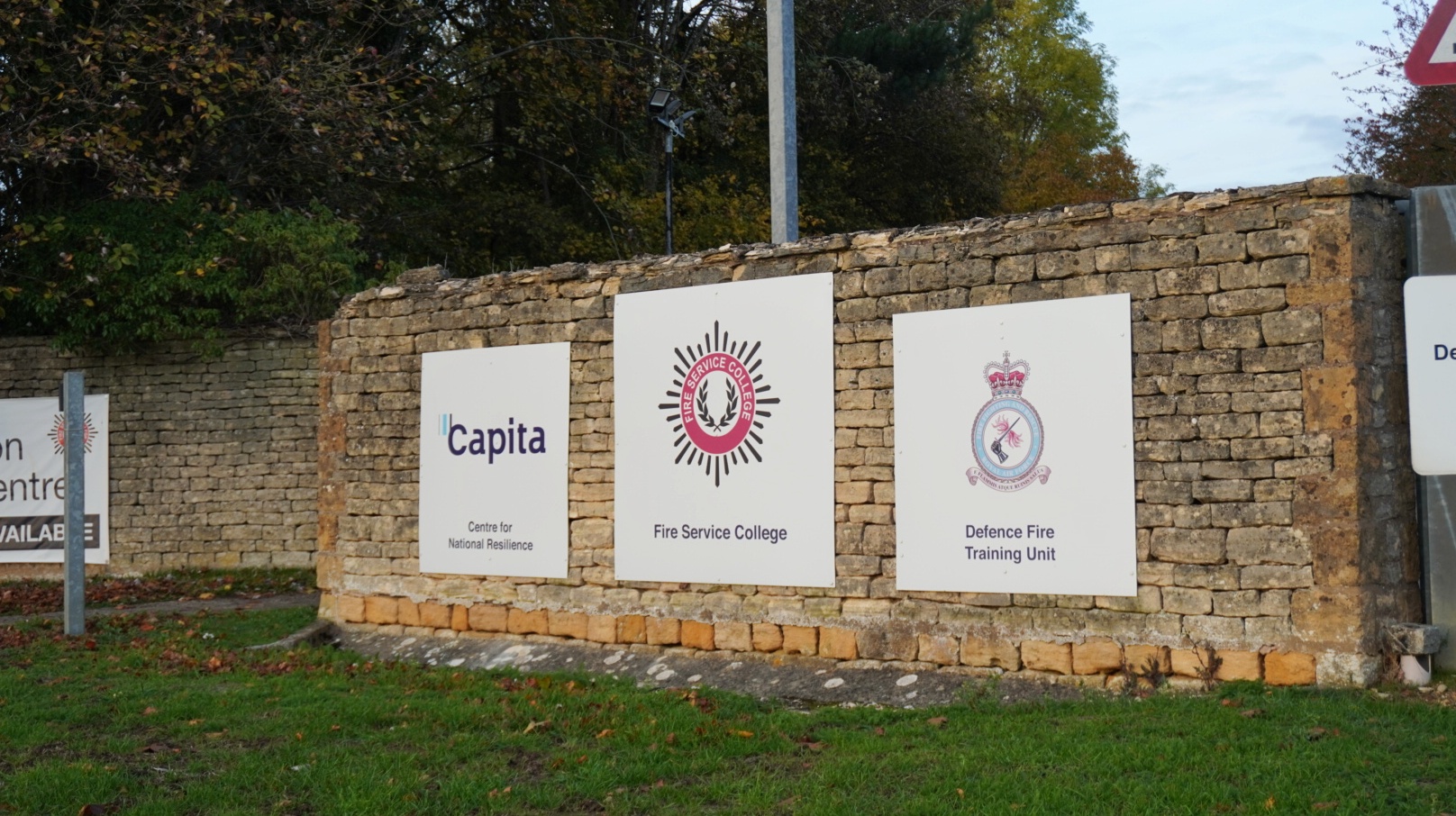
The Fire Service College has long been associated with the development of firefighters, but its modern role is wider than its name suggests. Its incident ground, classrooms, specialist facilities and increasingly sophisticated digital learning environments support the preparation of personnel from several emergency disciplines. The common objective is not simply to practise individual procedures. It is to develop the judgement, communication and coordination that allow those procedures to work under pressure.
Members of the media were invited to the Capita-operated College in October 2026, where Hume Jones, Managing Director for Critical Services at Capita, and Mark Lester, Operations Director at the Fire Service College, outlined its role in training and resilience. The briefing described a site of around 320 acres. According to figures presented on the day, more than 7,000 learners undertook regulated courses during 2025. Training activity extends well beyond local authority firefighters, embracing airport, industrial and defence firefighting as well as other emergency-response partners.

A national training ecosystem
For major incidents, the challenge rarely remains within the boundaries of one organisation. Firefighters may need to work alongside ambulance clinicians, Hazardous Area Response Teams (HART), police officers, military specialists, highway responders or other agencies. Each service has its own responsibilities and procedures. On a complex incident ground, the difficulty is making those different capabilities operate as one coherent response.
The College's facilities allow scenarios to be built around those interactions: who establishes command, how intelligence is shared, which hazards restrict access, how casualties are located and prioritised, and when one agency must wait for another to make a scene safe. That is the value of training in a controlled but demanding setting. Teams have an opportunity to test assumptions, discover friction and improve before an actual emergency exposes those weaknesses.
Technology before exposure
The College's Immersive Skills Lab, officially opened in January 2025 by the Princess Royal, represents a deliberate move towards technology-enhanced learning. Large free-roam virtual reality environments can place learners inside complex scenarios while allowing decisions and techniques to be examined without the full cost, exposure and logistical demands of a live exercise. Capita has made clear that this capability complements, rather than replaces, practical, physical training.
Demonstrations at the media day ranged from breathing apparatus and incident recognition to appliance driving, pump operations and other risk-specific training. An instructor can use virtual environments to examine a learner's situational awareness, ask why a decision was made and revisit a developing scenario. The training value is not the headset itself. It is the ability to pause, repeat, review and build understanding before putting that knowledge into practice in physically demanding conditions.

The possibilities are compelling. Could a developing firefighter learn to recognise warning signs in fire conditions before entering a hot training compartment? Could a new driver rehearse an unfamiliar response, or an appliance operator work through a pump problem before touching a real machine? Some of these ideas already sit within the College's blended-learning and augmented-reality programme.

There is a potential safety benefit too. Virtual scenarios do not generate the smoke and combustion products associated with a real fire, which may reduce the amount of live exposure needed for certain early learning tasks. That should not be overstated. Operational competence still requires hands-on training, exposure-control measures and realistic assessment. What the technology offers is another layer of preparation, not a shortcut around the fundamentals.
Does VR replace live fire?
No. The most defensible explanation is blended learning: theory, scenario rehearsal, decision-making and repeatable learning in the digital environment, followed by realistic practical application and assessment. The College itself identifies live incident-ground training as the essential setting in which learning is consolidated.
When aircraft emergencies are rehearsed
Aircraft rescue and firefighting demands a combination of speed, specialist knowledge and disciplined coordination. A developing fire can confront crews with fuel-related hazards, confined access, large structures and the urgent possibility of life rescue. Those pressures are difficult to recreate convincingly in a classroom, which is why dedicated aviation rigs remain so significant.

During the media event, crews tackled a simulated cargo-aircraft incident involving an engine and undercarriage fire, applying firefighting media in a controlled live-fire demonstration. Heat, appliance positioning, the choice and application of media and communication between crews all matter in training of this kind. The point is the opportunity to rehearse decisions and techniques against a dynamic, visible hazard.
Moreton-in-Marsh has invested in aviation training as the specialist landscape has changed. The College caters for firefighters from different professional backgrounds, including local authority wholetime and on-call roles, airport services, industrial environments and the military. Not all have the same operational role or training needs, but shared access to a specialist centre creates exposure to equipment, approaches and disciplines beyond a firefighter's usual station or establishment.
The A380-style rig: search, rescue and command, not flames
A second, separate facility addresses a different challenge entirely. The College's new Category 10 A380-style training rig is intended for cold exercises using synthetic smoke and reduced visibility. It is not used for live-fire training. The scenario is less about extinguishing a visible fire and more about finding people, navigating a large aircraft layout, coordinating searches and managing a complex rescue environment.

The Airbus A380 is the largest passenger aircraft ever built and is certified for a maximum of 853 passengers, though airline seating layouts are generally lower. Its size, double-deck layout and potential number of occupants illustrate why aircraft rescue planning cannot be limited to water and foam application. Search routes, evacuation, casualty handling, sectorisation and communication all take on a different scale. The A380-style rig gives responders a setting in which to work through those demands without introducing real flame.
Together, the two facilities illustrate a central point about realistic training: different risks call for different types of rehearsal. The cargo-aircraft rig develops response to fire conditions. The A380-style environment focuses on movement, search, rescue, incident command and the challenges of a large passenger aircraft. Their purposes are complementary, but they are not interchangeable.
Live fire vs cold training
Live-fire exercises introduce real flames and the practical constraints of tackling a fire in a controlled rig. Cold exercises may use synthetic smoke and other effects, allowing crews to concentrate on searches, movement, evacuation, communications and command without combustion. Both can play a role in a wider training programme. Neither should be described as doing everything the other does.
Under the rubble
A collapsed structure can be an incident of extraordinary uncertainty. Rescuers must consider unstable debris, void spaces, hazards above and below them, access restrictions and the possibility of casualties who cannot be seen or reached quickly. Technical skill is essential, but so is the ability to organise a search, communicate findings and work within a wider incident plan.

The College's Urban Search and Rescue (USAR) training environment includes purpose-built structures that allow teams to progress from confined-space and technical-search exercises to complex multi-level collapse scenarios. During the media day, a major simulated incident in the rubble-pile area brought together representatives of the fire service, police and ambulance HART. Sound, lighting, smoke and visual effects can challenge concentration and decision-making, while training controllers retain the ability to set and adjust the exercise.

Theatrical realism is not the same as training purpose. The noise and smoke are not there simply to make a dramatic photograph. Used appropriately, they complicate the information environment in which personnel must locate casualties, identify hazards and maintain communication. The realism lies in the problems the responders must solve and in the consequences their decisions have for the direction of the exercise.
For HART clinicians and other ambulance professionals, difficult access and hazards can affect how casualties are assessed and treated. Police may have different priorities around scene management, safety and evidence, while firefighters and specialist rescue teams focus on locating, accessing and releasing people. Exercises that make those priorities interact are valuable precisely because real incidents rarely fit the boundaries of a single training manual.
The motorway that never closes
At the Fire Service College, the M96 may be one of the only motorways where a major collision can be deliberately staged without closing a public road. This four-lane mock motorway allows responders to practise incidents involving multiple vehicles, casualties, fuel or other hazards, and the complicated movement of emergency personnel around a road traffic collision.
For an incident commander, a serious motorway incident demands more than an understanding of vehicle stabilisation and extrication. It requires space management, identification of developing hazards, access and egress planning, coordination with ambulance and police colleagues, and the ability to make a scene safer while protecting casualties. The controlled environment makes those choices visible and open to discussion.
The adjacent road traffic collision training facilities extend the opportunity for teams to work on vehicle access, rescue techniques and casualty-focused decision-making. The M96 is especially effective at illustrating interoperability: different responders need to carry out separate tasks without compromising the same shared scene.
Back to fundamentals
The growing use of digital simulation does not lessen the importance of breathing apparatus competence. At Moreton-in-Marsh, the dedicated BA training environment remains part of the College's core offering, giving new learners and experienced firefighters structured opportunities to develop or refresh the disciplined procedures required to work safely in respiratory hazards.
The media visit also highlighted work associated with Dräger breathing apparatus. The editorial value lies in connecting the human factors, including checks, team discipline, communication and emergency procedures, with the equipment on which firefighters depend.
Across all these environments, the instructor remains central. A rig can reproduce smoke, flames or a pile of debris. It cannot, by itself, interpret a poor decision, challenge an assumption or offer the practical insight that comes from experience. Technology enhances the possibilities for training, but people still turn exercises into professional learning.
A campus built for residential learning
What can be missed in images of burning aircraft and collapsed buildings is that the Fire Service College is also a residential training campus. Its 430 en suite bedrooms, made up of 270 doubles, 30 double/twins and 130 singles, allow learners attending from across the UK and beyond to remain on site while completing courses. The College also provides catering, recreational facilities and spaces for rest and reflection.

At the heart of that side of College life is the Officer's Mess, a large social space where learners and staff eat, meet and unwind after a day on the training ground. It is the informal centre of the campus: somewhere a course can debrief over dinner, compare notes with firefighters from other services or simply step away from the incident ground for an hour. A restaurant and bar, fitness facilities and a 25-metre indoor swimming pool add to the environment in which courses take place.
There are also dedicated prayer and reflection facilities, including a memorial chapel and prayer areas. When a learner has travelled away from their own service or base for a course, the infrastructure surrounding the training can support concentration, wellbeing and the informal professional exchange that happens between programmed sessions.
There is a human dimension here too. Firefighters from different services, airports, industrial establishments or military units can learn from each other away from the training rig. Conversations over a meal or in a communal space may be less spectacular than a live-fire exercise, but they are part of the experience of a residential training establishment.
Why this matters
The value of the Fire Service College is not that it can create the loudest, hottest or most visually dramatic exercise. Its significance is that it allows complex emergencies to be examined before they occur, helping responders understand both their own responsibilities and the capabilities of the agencies likely to be working beside them.
From a firefighter learning the fundamentals of breathing apparatus, to specialist crews rehearsing an aircraft evacuation, to a multi-agency team working through a collapse scenario, the objective is consistent: turn uncertainty into familiarity, and familiarity into better-informed action. The public may never see the hours spent in simulation, briefing or debrief. In a major emergency, however, that preparation may become one of the most important things the responders bring with them.
At a glance
- Location: Moreton-in-Marsh, Gloucestershire
- Site size: around 320 acres, according to the October 2026 media briefing
- Learners: more than 7,000 on regulated courses in 2025, according to figures presented at the briefing
- Accommodation: 430 en suite bedrooms (270 double, 30 double/twin, 130 single)
- Aviation: two separate rigs, a cargo-aircraft live-fire rig and a cold-training A380-style rig using synthetic smoke
- A380: certified for a maximum of 853 passengers, though airline layouts are generally lower






Comments
No comments yet — be the first!