The Results Are In
A week ago we asked a simple question: Is the Retained Duty System as We Know It Broken?
185 of you voted. Sixteen of you took the time to write a comment — current firefighters, ex-forces recruits, and retired officers with decades of duty between them. The conversation was one of the best we've had on the Hub, and it deserves to be pulled together rather than left to scroll away.So here's what you told us.
Pay Won — But Not By the Margin You Might Think
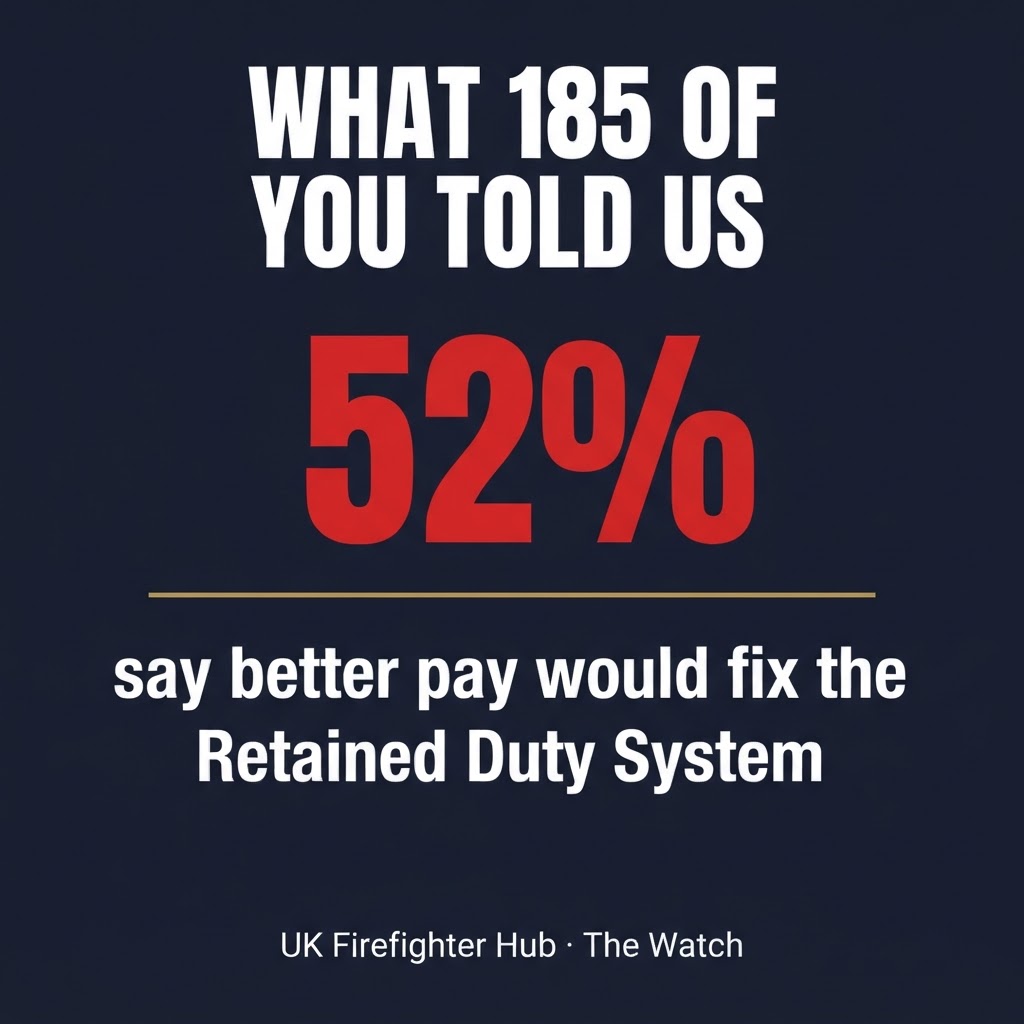
The headline number: better pay and retention incentives took 96 of 185 votes — just over half. Nobody who's followed the recruitment crisis will be surprised that money came top.
But look at what came second.
Relaxing the 5-minute response rule took 32 votes — 17% of everyone who voted. That's the rule that requires on-call firefighters to reach their station within five minutes of being alerted, and it's clearly the one that frustrates people most after pay.Here's the full breakdown:
How 185 of you voted (July 2026)
"Wholetime Commitment for On-Call Conditions"
If there was a thread running through your comments, it was this: the gap between what's expected of an on-call firefighter and what they're paid and protected for has become unsustainable.
Tony Greene put it plainly:
"The expectations which fire & rescue services expect today has grown massively, not only operationally but theoretically. The requirement to be able to have a socially acceptable work-life balance is becoming difficult. The continuous monitoring and the need to hit monthly targets feels like big brother. The comment 'a firefighter is a firefighter, wholetime and on-call comparison is good' is good from a management point of view, but the reality on-call is much different."
He listed what's now crammed into the role — community safety, smoke detector fits, school visits, SSRI's, PDR reviews, recruitment, monthly returns, availability contracts, equipment maintenance, operational exercises — and the unpaid home study that has grown around it.
"Trying to cram all the necessary training into a session each week is very unlikely. The expectations for individuals to complete more home study for no extra pay has also expanded dramatically."
"Amalgamate, Don't Close"
John Phillips, a reader in rural Wales, argued the model itself needs redesigning around how communities actually live now — and that the answer isn't closing stations, but merging the quiet ones.
"I do think it's broken. In an ideal world, I'd like to see more wholetime stations clustered and amalgamated. Merging quieter on-call stations to create wholetime, or day-staffed stations, could improve overall appliance availability, allow for a greater focus on prevention work, and would guarantee a level of service for residents. I do not, however, condone or agree with the closure of stations with no suitable replacement. This has to be an investment in communities."
His local example was pointed: a busy retained station sitting 12 minutes' drive from a quiet one with, in his words, "abysmal availability." Relocate the busy one to the bypass, he said, and both communities get a faster, more reliable response.
A Retired Officer's Blueprint
Jerrold Maycock served 30 years, mostly on a Day Crewing system with RDS backup, and he came with specifics rather than feelings:
"I feel that the response time needs looking at. Five minutes is too short — maybe 10 minutes for the first appliance, 15 for the second where applicable. Contracted hours should also be more favourable to modern living circumstances. 80% cover is way too much for most; 50% is more sociable."
He also floated a "Reserve Watch" that could be deployed to stand by retained stations turning out 300–600 times a year — a middle ground between wholetime and pure on-call.
The Recruitment Angle Nobody's Using
Matt, a former Royal Marine who joined on-call in his village, had the sharpest practical point of the whole thread: the fire service is sitting on a pipeline of ex-forces recruits and barely using it.
"I just presumed I was too old to join the Fire Service. I knew the wholetime had a long waiting list, and every recruitment poster shows young women. When I was asked if I was interested, I jumped at the chance to support my village. As a former Royal Marine I didn't really struggle with the bleep test, but a lot of people did. I've suggested several times there should be an on-call recruitment team that visits military bases where service leavers are on course. Ex-forces simply don't know about 'on-call'."
He's personally recruited four people into the service through charity work. He offered to give a 20-minute talk on behalf of his fire and rescue service. He says it "falls on deaf ears."
"I've found the fire service have a vast amount of experience, but some 'on-call' join with experience, and you aren't listening to us."
The Old Hands Remember a Different Union
Sean Michael, writing from the 1980s, pointed at something cultural that the statistics can't quite capture — the shift in what the fire service gets called to, and how the union once viewed wholetime firefighters serving on retained stations:
"I remember in the 80s the FBU was very much against wholetime firefighters being retained at their local retained station, but we had a few W/T at my station and it was great having their experience and training. I believe any wholetime covering their local station would definitely help availability. Also — is it just me, or does the fire service get called to everything now, not just fires and RTCs like the old days?"
So What Now?
Three things stood out across everything you wrote.
First, pay is the headline — but it's not the whole story. Even the readers who voted for it framed it as pay matching the commitment, not just a flat rise.
Second, the 5-minute rule and the 80% availability contract are the two structural pressures people feel most often. Jerrold's numbers — 10 minutes, 50% cover — are the most concrete proposal on the table.
Third, there's experience and goodwill being left on the floor — ex-forces recruits, experienced on-call firefighters, retired officers with workable models. Several of you said the same thing in different words: you aren't listening to us.
So here's the sharper question. Last week we asked what would help fix the system. This week we want to know what would actually keep you in it — or bring you to it.
Vote below, and if you've got a view, the comments are open.
What would actually make you stay — or sign up — as an on-call firefighter?
39 votes cast · Results update every 5 minutes
This poll is completely anonymous. No personal data is collected or stored. Results are indicative only and are not affiliated with the FRU, FRSA, the National Employers, or any other body.
Read the Original
If you missed it, the full piece — with the LGA workforce data, the Welsh figures, and the case for redesigning rural cover — is here.
Get It All in Your Inbox
Fire service news, firefighter vacancies and our latest videos — delivered straight to you. No spam, unsubscribe anytime.
Just after the jobs?Sign up for job alerts only →









Comments
No comments yet — be the first!